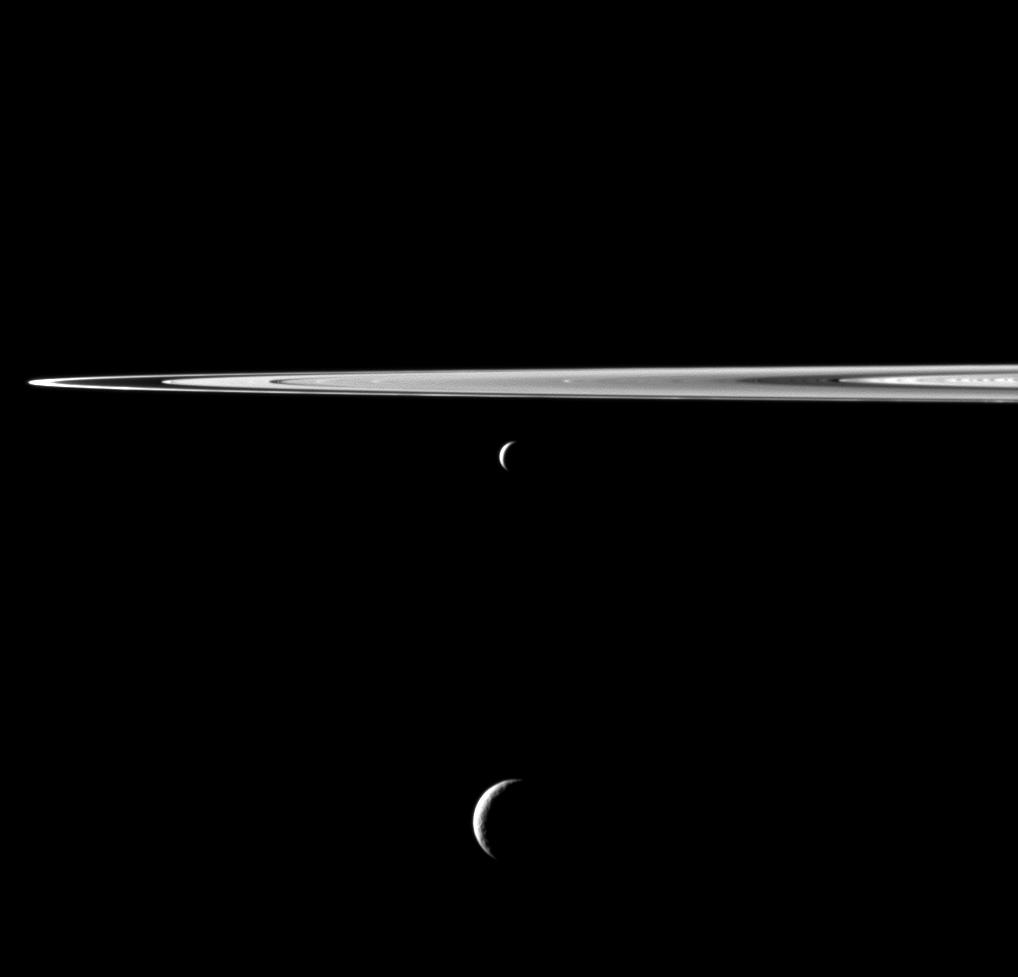
A pair of Saturn's moons appears as if hung below the planet's rings in this Cassini spacecraft view.
Enceladus (313 miles, or 504 kilometers across) appears just below the
rings here, near the center of the image. Tethys (660 miles, or 1,062
kilometers across) is near the bottom center of the image. Tethys is
closer to Cassini than is Enceladus.
This view looks toward the northern, sunlit side of the rings from just above the ringplane.
The image was taken in visible light with the Cassini spacecraft
wide-angle camera on Sept. 13, 2011. The view was obtained at a distance
of approximately 169,000 miles (272,000 kilometers) from Enceladus and
at a Sun-Enceladus-spacecraft, or phase, angle of 135 degrees. The view
was obtained at a distance of approximately 129,000 miles (208,000
kilometers) from Tethys and at a Sun-Tethys-spacecraft, or phase, angle
of 135 degrees. Image scale is 10 miles (16 kilometers) per pixel on
Enceladus and 7 miles (12 kilometers) per pixel on Tethys.
The Cassini-Huygens mission is a cooperative project of NASA, the
European Space Agency and the Italian Space Agency. The Jet Propulsion
Laboratory, a division of the California Institute of Technology in
Pasadena, manages the mission for NASA's Science Mission Directorate in
Washington. The Cassini orbiter and its two onboard cameras were
designed, developed and assembled at JPL. The imaging team is based at
the Space Science Institute, Boulder, Colo.
For more information about the Cassini-Huygens mission visit http://saturn.jpl.nasa.gov or http://www.nasa.gov/cassini . The Cassini imaging team homepage is at http://ciclops.org .
Credit: NASA/JPL-Caltech/Space Science Institute


No comments:
Post a Comment
Note: only a member of this blog may post a comment.